Ministry for Regulation news – July 2026
28 July 2026

Kia ora
One of the things that’s struck me most since stepping into this role is how often regulation is talked about in pieces.
A rule here. A process there. A fix to a specific problem.
Regulation is a system. It’s the rules, yes, but also the people applying them, the agencies responsible for them, and the way they land for New Zealanders trying to get things done. When you change one part of that system, it doesn’t sit neatly in place. It shifts pressure somewhere else.
That’s where we need to be careful.
Because a change that looks like a clear improvement in one area can create cost, confusion, or risk in another.
There are hundreds of organisations playing a role in regulation across New Zealand, spanning central government, local government, and statutory bodies.
No one experiences that as a neat structure. They experience it as a journey across multiple touchpoints, rules, and decisions.
If we want to make regulation work better, we have to step back and see the whole picture.
As a Ministry, we are deliberate about how our work fits together. Reviews, system mapping, and capability support are not stand-alone activities – they are parts of the same effort to improve how regulation works in practice. That matters because the problems we’re trying to fix don’t sit neatly in one place.
One of the most valuable things we’ve done is to map who regulates what, and how those pieces connect.
It’s not glamorous work, but it’s foundational. You can’t improve a system you don’t fully understand.
For me, this is really about moving from fixing individual issues to asking better questions:
- Are we solving the right problem?
- Are we shifting the burden somewhere else?
- Are we making it easier or harder for people this most affects?
The Ministry’s role isn’t to own every rule; it’s to help the system work as a whole.
Because regulation isn’t abstract. It shapes how people build, trade, work, and live. When it works well, it enables. When it doesn’t, it gets in the way.
Taking a system view doesn’t make the work easier. But it will lead to better results.
Ngā mihi nui
Gráinne Moss
Secretary for Regulation and Chief Executive
Ministry for Regulation

New requirements and guidance for agencies
On 1 July, the requirements under Part 2 of the Regulatory Standards Act came into force, alongside Cabinet's new expectations for good law-making. We have updated the Ministry's website to help agencies understand what they need to do when developing policy and legislation, including:
- Updated guidance and templates for Consistency Accountability Statements (CASs) and supporting accountability documents
- Updated regulatory impact analysis requirements, including Regulatory Analysis Summaries (RASs)
- Publication requirements and technical guidance for accountability documents
- Step-by-step guides for preparing Bills, secondary legislation and Government amendment papers
- The Regulatory Standards (Excluded Legislation) Notice 2026
To support agencies with these changes, the Regulatory Impact Analysis team also hosted a series of webinars covering the transition from RISs to RASs, exemptions from impact analysis requirements, publishing RASs, and managing situations where impact analysis is incomplete. Recordings and presentation materials are available to government agencies through RIA Online.
Requirements and guidance for agencies
Regulatory Standards Board begins its work
The Regulatory Standards Board is also now in place and has begun its work under the Regulatory Standards Act (the Act), including considering complaints about existing legislation and considering the quality of Consistency Accountability Statements prepared for new legislation.
The Regulatory Standards Board is an independent statutory body established under the Act. See more on the functions on the board and how to make a complaint about legislation you consider is inconsistent with the principles of the Act.
Regulatory Standards Board and complaints portal
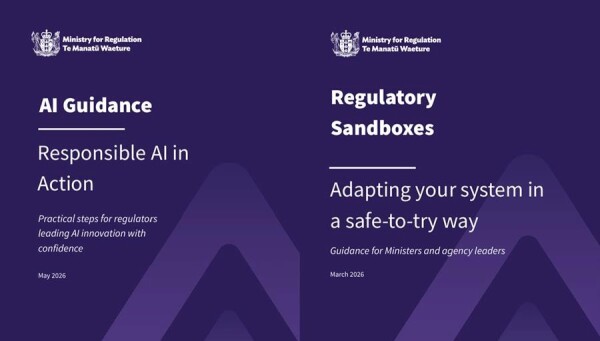
Have your say on our resources for regulators
If you've used any of the resources listed below, we'd love to hear from you.
• Regulatory Sandboxes: Adapting your regulatory system in a safe-to-try way
• AI Guidance: Responsible AI in Action
• Leadership reflections (video series)
• Quick guides to good regulatory practice
Our short, anonymous survey takes less than 5 minutes to complete and will help us understand what's working well, what could be improved, and what future resources and support would be most valuable to regulators and people in regulation.
The survey closes 7 August
Resources for regulators surveyopen_in_new

What drives better regulatory outcomes?
According to Alex McMinn, Head of Regulatory System Capability at the Ministry for Regulation, it's about more than training or credentials.
In a recent interview with The Modern Regulator, Alex reflects on lessons from 15 years working in New Zealand's regulatory system and discusses the role that governance, leadership and stewardship play in creating effective regulatory systems.
He also shares his perspective on why many regulatory challenges stem from how systems are designed and governed, rather than from legislation or frontline capability alone.
What 15 years in NZ's regulatory system teaches youopen_in_new
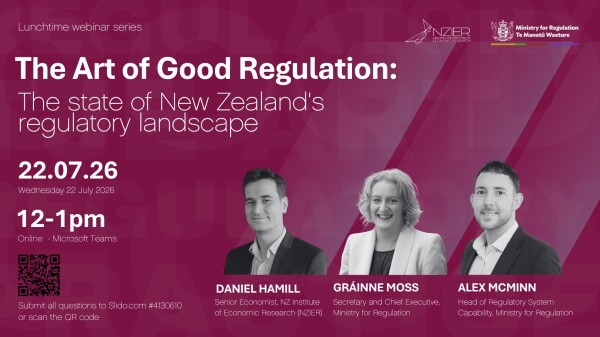
What does the regulatory landscape look like from a citizen's perspective?
In the latest webinar in NZIER's Quality of Regulation Masterclass Series, our Chief Executive Gráinne Moss and Head of Regulatory System Capability Alex McMinn joined NZIER Senior Economist Daniel Hamill to explore the state of New Zealand's regulatory landscape.
Together they talked about the holistic view of the regulatory landscape and how important it is to understand it from a citizen's perspective, in particular the effect that cumulative regulation can have on people in their everyday lives.
Watch the recordingopen_in_new

Toy safety reforms prompted by Red Tape Tipline
A concern raised through the Ministry for Regulation’s Red Tape Tipline has led to changes that will make it easier to supply toys in New Zealand. The Government has agreed to update toy safety regulations to better align with Australia and recognised international standards, reducing unnecessary compliance costs while maintaining strong safety protections. Modelling estimates the change could deliver a net benefit of up to $6.8 million over 10 years.
Removing barriers to supplying toys in New Zealand
Strategic Intentions updated for the Ministry's next phase
The Ministry for Regulation has published its Strategic Intentions 2026/27–2029/30, updating the first Strategic Intentions developed shortly after the Ministry was established. The refreshed document reflects the Ministry's evolution from a new agency to a system leader, setting out the role we play in improving the quality of regulation, reducing unnecessary regulatory burden, and strengthening transparency, decision making and stewardship across government. It also outlines the priorities that will guide our work over the next four years.

Our 2027 graduate programme applications are now open
It's hard to believe our first graduates are already almost six months into the programme. Since joining the Ministry in February, they've been getting stuck into real work across our Digital and Insights, Economics, and Ministerial and Strategic Services teams, while building connections across the public service and learning what regulation looks like in practice. More recently, they've been sharing their experiences with prospective applicants through graduate webinars, careers expos and stories.
Meet the graduates Q&A videoopen_in_new
Applications are now open for our 2027 Graduate Programme. If you know someone who might be interested, please pass it on. Applications close on 9 August.
If you're interested in receiving updates directly to your inbox, make sure you sign up to our mailing listopen_in_new
Keep up to date with our latest news by checking out this website, and follow us on LinkedInopen_in_new